Google Tag Manager
Audit
A Google Tag Manager audit that covers your full container stack: GTM standard, GTM 360, or server-side GTM. We audit every data layer, tag, trigger, variable, and custom HTML script to identify misconfigurations that collapse marketing performance, create security vulnerabilities, and violate consent requirements. Categorized findings report with priority levels delivered in 5-7 business days.
Start Your GTM Audit
For growing businesses · 5-day turnaround
Your container data is confidential. Read-only access only.
Why GTM Containers Break Your Marketing Performance
A single misconfigured tag, trigger, or variable can silently break your entire measurement stack. These are the five most common GTM failures we uncover during audits.
Misconfigured GTM containers create a cascade of failures. Tags fire on the wrong pages. Triggers scope too broadly or too narrowly. Variables pull incorrect data layer values. The result: GA4 receives garbage data, conversion counts are wrong, and every marketing decision downstream is based on numbers that do not reflect reality. A single trigger condition error can silently invalidate months of campaign reporting.
Custom HTML tags in GTM inject arbitrary JavaScript into your website. Scripts added years ago for abandoned campaigns, deprecated integrations, or one-off experiments remain active in the container. These old scripts reference external domains that may have been sold, compromised, or hijacked. An attacker who controls one of those external domains can execute malicious code on every page where that tag fires. Without regular audits, your GTM container becomes an open door for supply-chain attacks on your website.
Consent mode V2 requires GTM tags to respect user consent signals before firing. Without proper integration between your consent management platform and GTM, marketing and analytics tags fire before the user grants consent. This violates GDPR, CCPA, and ePrivacy regulations. Beyond legal exposure, non-compliant setups also cause GA4 to model behavioral data incorrectly because consent signals are missing from the data it receives.
Development teams launch new page templates, landing pages, and site sections without verifying that the GTM container snippet is present. Even when the container loads, existing triggers often do not cover new URL patterns or page structures. The result: zero tracking data on those pages. No events, no conversions, no user behavior captured. These gaps compound over months as more pages launch without container coverage or trigger updates.
Server-side GTM is no longer optional for organizations that depend on accurate data. Ad blockers, privacy browsers, and ITP restrictions block 25-40% of client-side GTM requests. First-party cookie durations are capped at 7 days in Safari. Without sGTM routing hits through your own domain, your GTM container loses a significant share of real traffic before data reaches GA4. The audit evaluates your sGTM readiness and provides a migration path if you are still running client-side only.

What is a Google Tag Manager Audit?
A Google Tag Manager audit is a systematic review of your GTM container architecture, tag configurations, trigger logic, variable definitions, custom HTML security, consent mode integration, and data layer accuracy. Waftr audits GTM standard, GTM 360, or server-side GTM containers. We identify misconfigurations that cause tag misfires, data loss, security vulnerabilities, and consent violations, then deliver a prioritized remediation roadmap.
A GTM audit typically uncovers:
- Tag firing failures: Tags scoped to wrong pages, duplicate tags performing the same function, tags firing out of sequence, or tags that stopped working after container updates but were never caught.
- Trigger logic errors: Overly broad triggers firing on all pages instead of specific URL patterns, missing trigger conditions for new page templates, or conflicting trigger groups that prevent correct tag execution.
- Variable and data layer mismatches: Variables pulling incorrect or undefined data layer values, data layer pushes happening after tags fire instead of before, or custom JavaScript variables returning inconsistent results.
- Security vulnerabilities: Old custom HTML tags referencing expired external domains, abandoned scripts from deprecated campaigns, or third-party code injected without security review that creates supply-chain attack vectors.
- Consent and privacy gaps: Tags firing before consent is granted, consent mode V2 not integrated with GTM, or consent state not passed correctly to downstream platforms like GA4 and Google Ads.
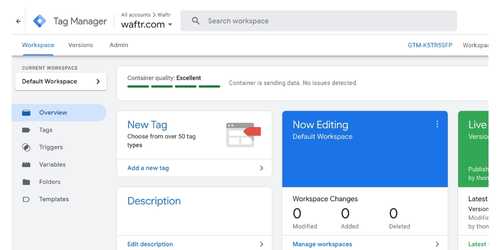
What Waftr's GTM Audit Covers
Click a service area to see how Waftr approaches each part of your GTM audit.
Complete container architecture review: standard, 360, and sGTM.
We audit your full container inventory. Every workspace, version, and environment is reviewed for consistency. Container naming conventions, folder organization, and access permissions are validated. For GTM 360, we additionally review zones, approval workflows, and enterprise governance controls.
Orphaned containers still firing on pages, duplicate containers creating conflicting tag executions, and containers missing from new page templates are all flagged with specific page URLs and remediation steps.
Talk to an ExpertEvery tag validated for firing logic. Every trigger checked for scope accuracy.
Each tag is mapped to its trigger and validated for correct firing: right pages, right events, right sequence. Duplicate tags, abandoned campaign tags, and tags with broken configurations are identified. Tag sequencing dependencies are traced to prevent race conditions where one tag fires before the data it needs is available.
Triggers are reviewed for scope accuracy. Overly broad page view triggers, missing exception conditions, and URL pattern mismatches for new page templates are documented. Custom event triggers are validated against actual data layer pushes.
Talk to an ExpertVariable definitions validated against your data layer schema.
Every variable is checked: data layer variables confirmed against actual push events, constant variables verified for correct values, custom JavaScript variables tested for consistent output. We identify variables that reference undefined data layer keys, variables with stale default values, and lookup tables with missing entries.
Data layer implementation is reviewed for timing, structure, and completeness. We confirm that data layer pushes happen before tags that depend on them fire, and that your data layer schema matches the variable configurations in GTM.
Talk to an ExpertConsent mode V2 verified end to end: CMP to GTM to GA4.
We verify that your consent management platform correctly communicates consent state to GTM, that all tags respect consent signals before firing, and that consent mode V2 parameters are passed accurately to GA4 and Google Ads. Tags that fire before consent is granted are flagged as compliance violations.
For teams using Cookiebot, OneTrust, or other CMPs, we validate the GTM integration layer: consent initialization timing, default consent states, region-specific consent rules, and TCF 2.0 signal passthrough. Each gap is documented with regulatory context and fix priority.
Talk to an ExpertServer-side GTM: audit existing setups or assess migration readiness.
For existing sGTM deployments, we audit client configurations, transport URLs, first-party domain routing, server-side tag templates, and consent signal passthrough. We verify that server-side processing matches client-side intent and that no data is lost in transit between client and server containers.
For organizations still running client-side only, the audit includes a migration readiness assessment. We identify which tags can move server-side, estimate the signal recovery from bypassing ad blockers, and provide a phased migration plan. Client-side-only GTM is no longer sufficient for organizations that depend on accurate measurement data.
Talk to an ExpertWho Needs a Google Tag Manager Audit
If any of these describe your situation, a GTM audit will prevent compounding configuration problems.
Marketing teams with declining conversion accuracy
GA4 conversion counts no longer match ad platform reports. Tags are misfiring, duplicate events inflate numbers, and nobody knows which GTM changes caused the discrepancy or when it started.
Dev teams that inherited a GTM container they did not build
Previous agencies or contractors configured the container. Documentation is missing, tag naming is inconsistent, and nobody on the current team understands why specific tags exist or what triggers control them.
Security-conscious organizations with custom HTML in GTM
Custom HTML tags inject third-party JavaScript into your website. Old scripts reference external domains that may have been compromised. A security review identifies vulnerable scripts before they become attack vectors.
Companies preparing for server-side GTM migration
Migrating to sGTM without auditing your current container carries every existing misconfiguration into the new setup. The audit establishes a clean baseline before migration begins.
Fast-growing sites launching new pages without tracking validation
New landing pages, product pages, and site sections go live without confirming that GTM containers are present and triggers cover new URL patterns. Each untracked page is a blind spot in your measurement.
Enterprises needing consent mode compliance validation
GDPR and CCPA require that analytics tags respect user consent. An audit verifies that consent mode V2 is properly integrated, no tags fire pre-consent, and your CMP communicates correctly with GTM.
Stop inheriting broken containers. Start with a clean GTM audit.
Talk to an ExpertRead-only access. Four steps. Every container, tag, trigger, and variable reviewed.
You grant us read access to your GTM account. We never publish changes to your container during the audit. We can connect directly with your dev team for implementation after delivery.
-
Container Access and Scope
Grant Waftr read-only access to your GTM account. We map every container across your properties, confirm which are active, and identify orphaned or duplicate containers running on the same pages.
-
Tag, Trigger, and Variable Audit
Every tag validated for correct firing. Every trigger checked for scope accuracy. Every variable confirmed for proper data layer mapping. Custom HTML tags reviewed for security vulnerabilities and script integrity.
-
Consent Mode and sGTM Assessment
Consent mode V2 integration verified end to end. Tags checked for pre-consent firing violations. Server-side GTM readiness evaluated with migration recommendations for containers still running client-side only.
-
Categorized Report Delivery
A detailed report with findings organized by severity. Each issue includes business impact, remediation steps, and priority level. We walk through findings with your team and can connect directly with your dev team for implementation.
What Changes After a GTM Audit
Every GTM audit produces a categorized findings report with fix priorities and projected results. Here is what the container looks like once remediation is complete.
Before the audit
- Tags misfiring on wrong pages due to overly broad trigger conditions
- Old custom HTML scripts creating security vulnerabilities
- New pages launching without GTM containers or trigger coverage
- Consent mode not integrated, tags firing before user consent
After remediation
- Every tag fires on the correct pages with validated trigger conditions
- Custom HTML scripts replaced with secure native tag templates
- Container deployed consistently across all pages and templates
- Consent mode V2 verified, all tags respect user consent signals
The audit report maps every finding to a specific fix with severity rating and estimated implementation time. Most teams close the critical issues within the first week. Tag firing accuracy improves immediately after trigger scope corrections. Security vulnerabilities from custom HTML tags are eliminated by replacing them with native GTM tag templates.
Many organizations follow the GTM audit with ongoing GTM consulting to maintain container health as campaigns launch and site architecture evolves. Others use audit findings as the baseline for a server-side GTM migration. The audit report serves as the foundation whether you implement fixes internally or with Waftr.
Why Choose Waftr for Your GTM Audit
Most agencies run a surface-level tag check. Waftr audits are built on 12+ years of GTM infrastructure experience and AI-assisted validation workflows.
12+ years in Google Tag Manager infrastructure
Waftr has been building GTM implementations since the platform launched. That depth means we catch configuration issues that surface-level auditors miss, from tag sequencing race conditions to custom HTML supply-chain vulnerabilities.
AI-assisted audits at a fraction of agency rates
Waftr uses AI tools to validate tag configurations, cross-check trigger logic, and scan for consent mode gaps across hundreds of tags simultaneously. That automation means deeper coverage at significantly lower cost than traditional agencies charging for manual-only container reviews.
We connect directly with your dev team
Waftr does not just deliver a report and disappear. We walk through every finding with your team, connect directly with your developers for implementation questions, and provide step-by-step remediation instructions they can execute without guesswork.
Read-only, zero-risk audit process
Waftr never publishes changes to your GTM container during the audit. Access is read-only. No shared passwords, no production changes, no surprises. You grant read access and we return a complete findings report.
Google Tag Manager Audit FAQ
Ready to fix your GTM container?
Start Your GTM Audit
Identify tag misfires, security vulnerabilities, and consent violations before they compound. Get a prioritized remediation roadmap within 5-7 business days.
Talk to an Expert